Identity as Belonging
June 10th - July 5th, 2022
HaSfina, The Oriah Shaviro Youth Center
Participating Artists: Kefaia Aiaite, Svika Altman, Polina Bar Cohen, Efrat Dorel, Shani Eldar, Chana Spitzer, Nadav Teitelbaum, Avi Talala, Libi Yaar Horowitz
In both Hebrew and English, the roots for the word “identity” mean “same.” When people define aspects of who they are -- their gender, social status, family status, political affiliations, nationality or race, etcetera -- they are declaring that they are the same as certain groups of people. So, the question “Who am I?” is actually “Which we am I part of?”
Sometimes, identity is determined for you, through your assigned gender, birthplace and skin color, with outside forces imposing an identity upon the individual, but much of it is fluid, and each person, in order to describe who they are to others, chooses their categories. But this can change over time, and people do not necessarily fit neatly into boxes. Each change in our identity can cause a crisis and/or a catharsis, as we switch allegiances to a different group or add another group to the list.
There are many ways in which aligning oneself as part of a group can be beneficial. Within the framework of Identity Politics, individuals can use their relationships to a group to help create systematic change that benefits them as individuals. The group can also become an individual’s community and provide access to information on how to navigate challenges that arise in relation to their identity. The different groups that make up a person’s identity can also conflict with one another, causing individuals to either give more weight to one aspect of their identity or to walk a thin line between two or more identities.
The artists in this exhibition all created works that dive deep into their identities and represent their relationships within certain groups and the difficulties that they encounter as part of those groups. Religion, immigration, and being a trauma survivor emerged as the works’ main themes. But these artists all contend with multiple, often conflicting, aspects of their identities; they could be grouped and regrouped in many ways.
I AM RELIGIOUS
Although the works of Nadav Teitelbaum, Svika Altman and Efrat Dorel are deeply connected to Judaism, each highlights different complications.
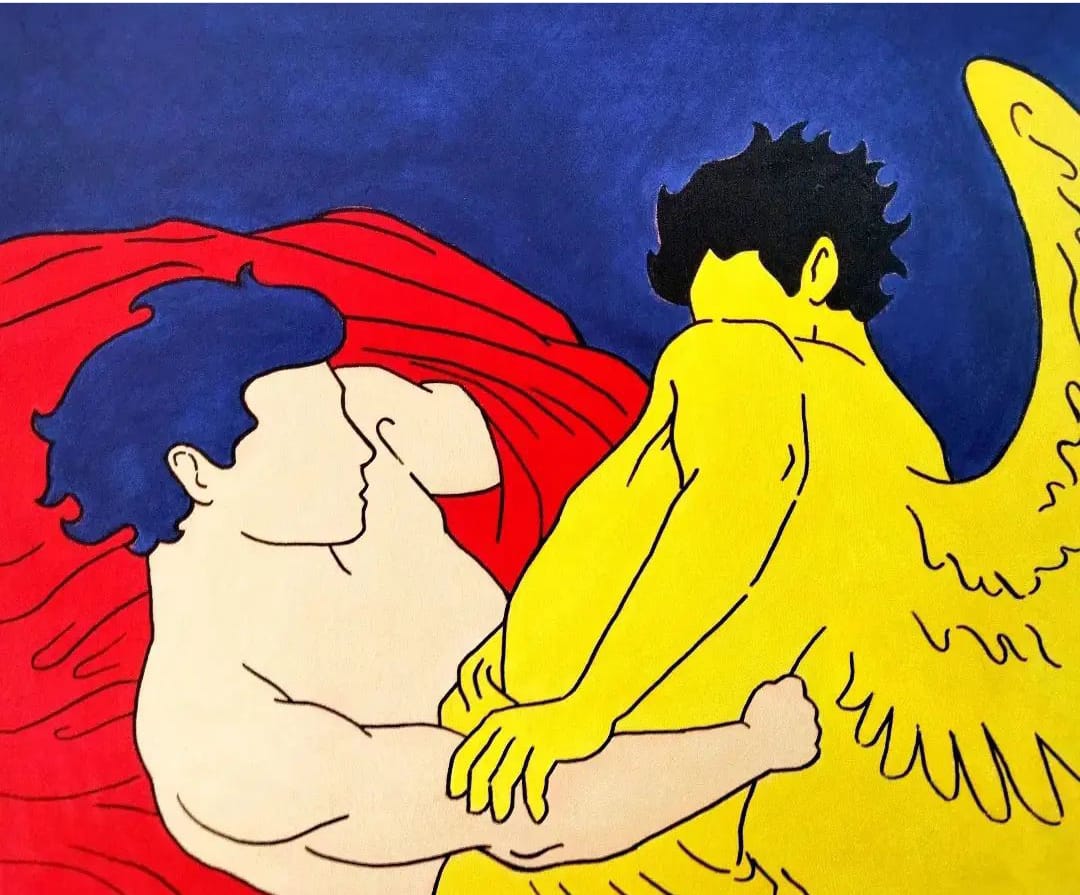
The works of Nadav Teitelbaum were created based on biblical themes and motifs while he was in Yeshiva and at the same time dealing with his homosexual orientation which he kept hidden. Despite his sexual orientation, he did not want to give up his commitment to religion and tradition. Through discourse with art history, he created homages to famous artworks depicting biblical scenes and gave them new meaning. Nadav abstracted the paintings, used bold fields of color and erased recognizable individual features. He thus transformed them into a general parable about conflict and also his own personal struggle. The work “Jacob wrestling with an Angel” echoes the conflict between the human and divine spirit, but just as in the story, it is not clear who is good and who is evil or which side wins. In the work, “The Binding of Isaac”, Nadav tries to address and raise questions about the divine commandment to constrain what is most precious to you. Both works deal with the clash between Nadav’s male-Jewish-religious identity and his homosexual identity. Nadav recently married his partner in a religious ceremony and continues to identify as both a homosexual and a Jew who keeps the Jewish traditions. In doing so, he is part of, and an exception within both groups, but he is also part of a growing subculture that accepts the coexistence of the two.
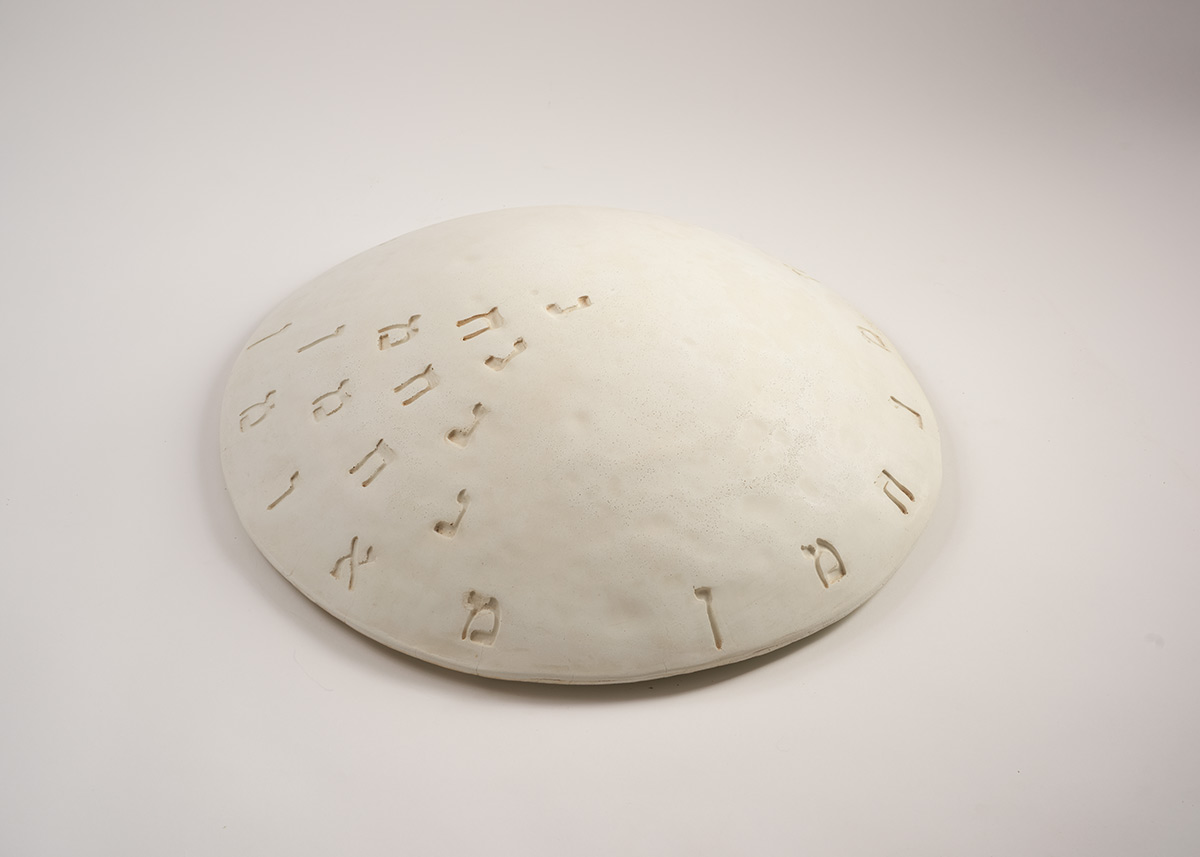
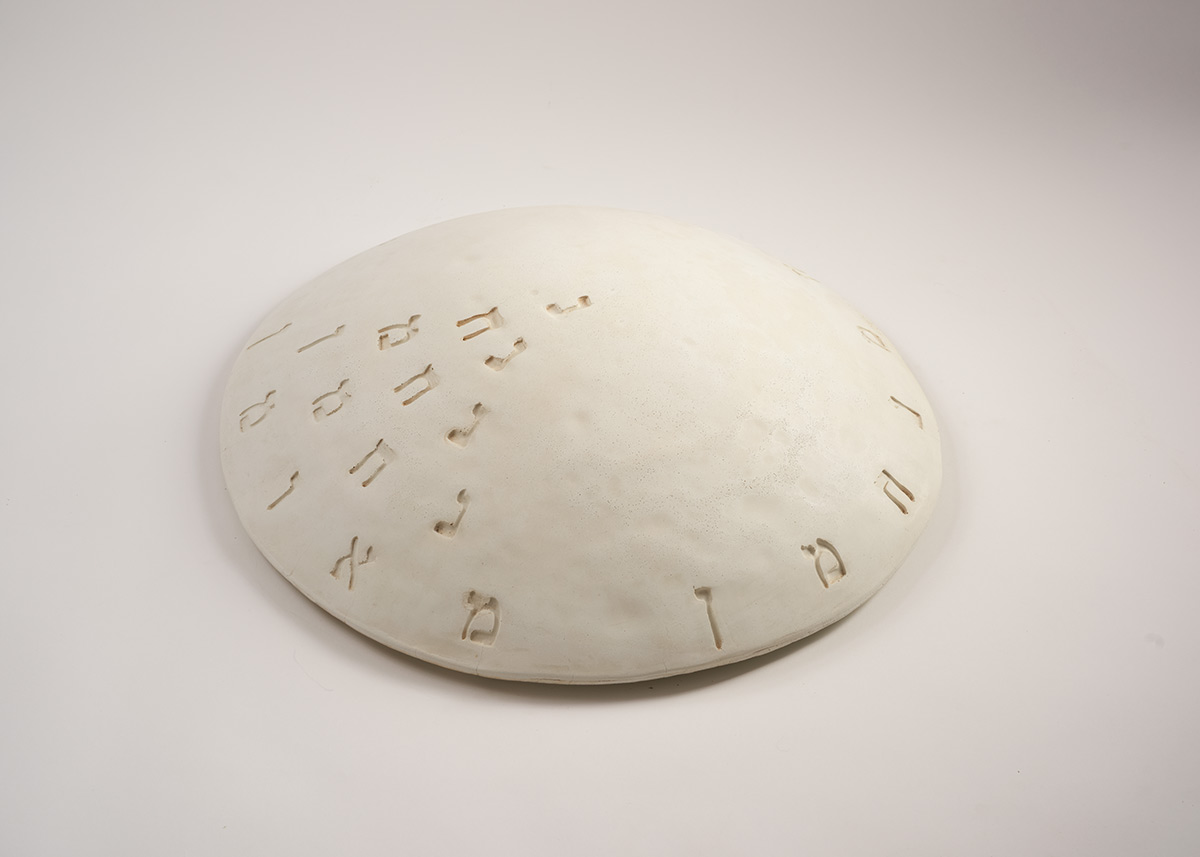
Svika describes himself as a person who is both not-religious and connected to many religions. He found himself drawn to his Jewish roots and often prays, puts on Tefillin, and studies Torah but he has also studied many Middle- and Far Eastern religions and connects with them as well. Svika is a scholar of Sufism, or Islamic mysticism (similar to Judaism’s Kabala) and he practices Sufi whirling, a traditional Sufi dance and meditation practice. In his video work, “One” which refers to the idea that God is one, Svika is seen from above wearing a kippah and a tallit and doing the Sufi dance to the sound of three voices, each singing a central prayer of the main monotheistic religions, the Jewish prayer “Shema Yisrael”, the Muslim prayer “Allahu Akbar” and the Christian prayer “Ave Maria”. Svika’s sculpture of wings draws from the imagery of the prayer shawl and his sculpture of the Nachman M’Uman kippah is inspired by Breslov, the spiritual sect of Judaism that also utilizes dance as an integral part of the religious practice. Svika sees connections between the different religions and aligns himself with many, and even though these alignments appear to conflict, for Svika, they are one and each provides him different access to the Creator.
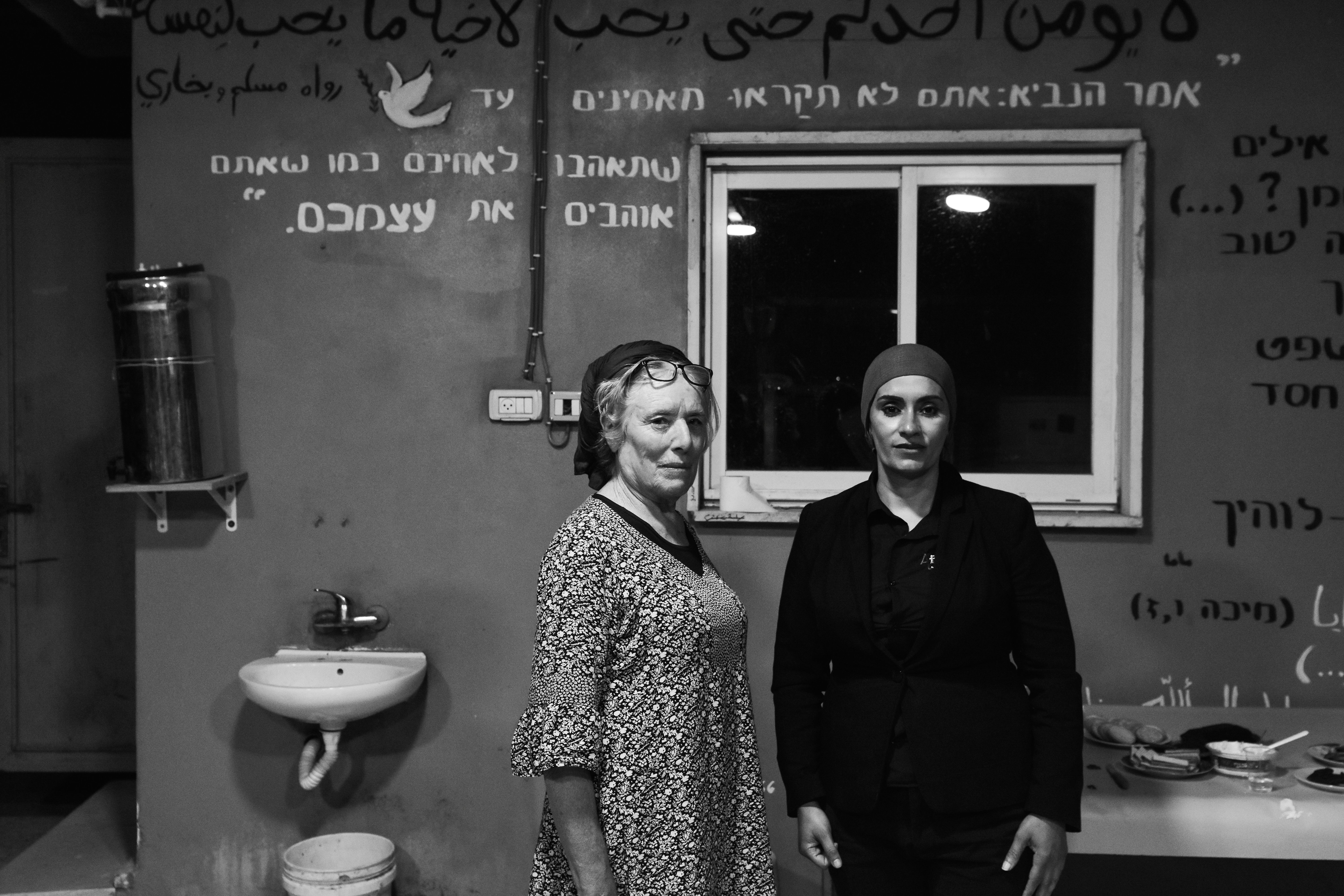
In Efrat Dorel’s photo series “B’shelah” - a word that can mean “ripe fruit” or “standing firm”, she features religious women who are true to their faith, even if it goes against the grain and even when their choices challenge accepted ideas of how a religious woman looks. Efrat began close to home, in her own small town in the Shomron, where she photographed a career army woman in a full head covering sitting on the stoop of her home with her child’s toy stroller behind her; a woman who is a Talmud scholar, and chose to teach women Halacha, studying the Talmud while holding her infant; and a group of women sitting on benches at the playground, all with full head coverings, except one, who decided not to. Each woman breaks stereotypes and boldly chooses a path that is unconventional, not always acceptable, and adheres to her truth. Recently, Efrat traveled to Gush Etzion to photograph Hadassah Froman, one of the founders of the organization “Roots” which brings together average Palestinian and Settlers to converse and get to know each other as human beings. On the wall behind the figures is a powerful quote from the Quran which promotes peace, and here Efrat photographed Hadassah Froman alongside a religious Palestinian woman who also works towards connection and inter-religious discourse. In another recent photograph, Efrat features a woman putting on tefillin, a Jewish ceremony usually reserved for men, but here - out of a deep affinity and a desire to connect with the Creator - she dons a pair of tefillin. In another photograph, Efrat captures two religious women, who have chosen to marry each other, who have decided that despite the conflict with their religion, it would be wrong to give up their love. They both cover their head hair, and live a life devoted to Halacha and the love of God. Efrat sees herself in each of these women; as she researches and learns how to balance the contradictions she feels inside herself, she learns what is right and true for her and what are only social barriers.
I AM A SURVIVOR
Hana Libi Yaar, Shani Eldar and Kefaia Aiaite suffered intense trauma and then were consumed by health problems that are connected to their traumatic experiences. They are part of a club that no one chooses to belong to, but that inevitably becomes a huge part of their identities as they contend with the pain, both physical and emotional.
Hana Libi Yaar lives with Dissociative Identity Disorder (DID), which for her manifests as 10 different identities living in one body. Libi, the primary identity, explained that before her diagnosis seven years ago, she did not understand what was happening to her and was not aware of all her identities. Sometimes she would black out, and not know what happened or how she got where she is, later learning that one of her other identities had taken over her body. DID is a protective response to trauma, allowing the primary identity to be unaware of an experienced trauma, because “it happened to a different identity”. Over time, and with the help of therapy, Libi has gotten to know some of her other identities and has come to better understand the trauma she experienced as a young girl. Not all of her identities are artists like her; some of them are children of various ages and “Yaar” is not even human, she is a fairy. Exhibited is one of Libi’s artist journals, which she started in order to better connect to all her selves; whichever identity enters the studio creates a work on a new page of the book. Libi never alters after the entries. She invites the viewer to turn the pages and get to know her different selves.
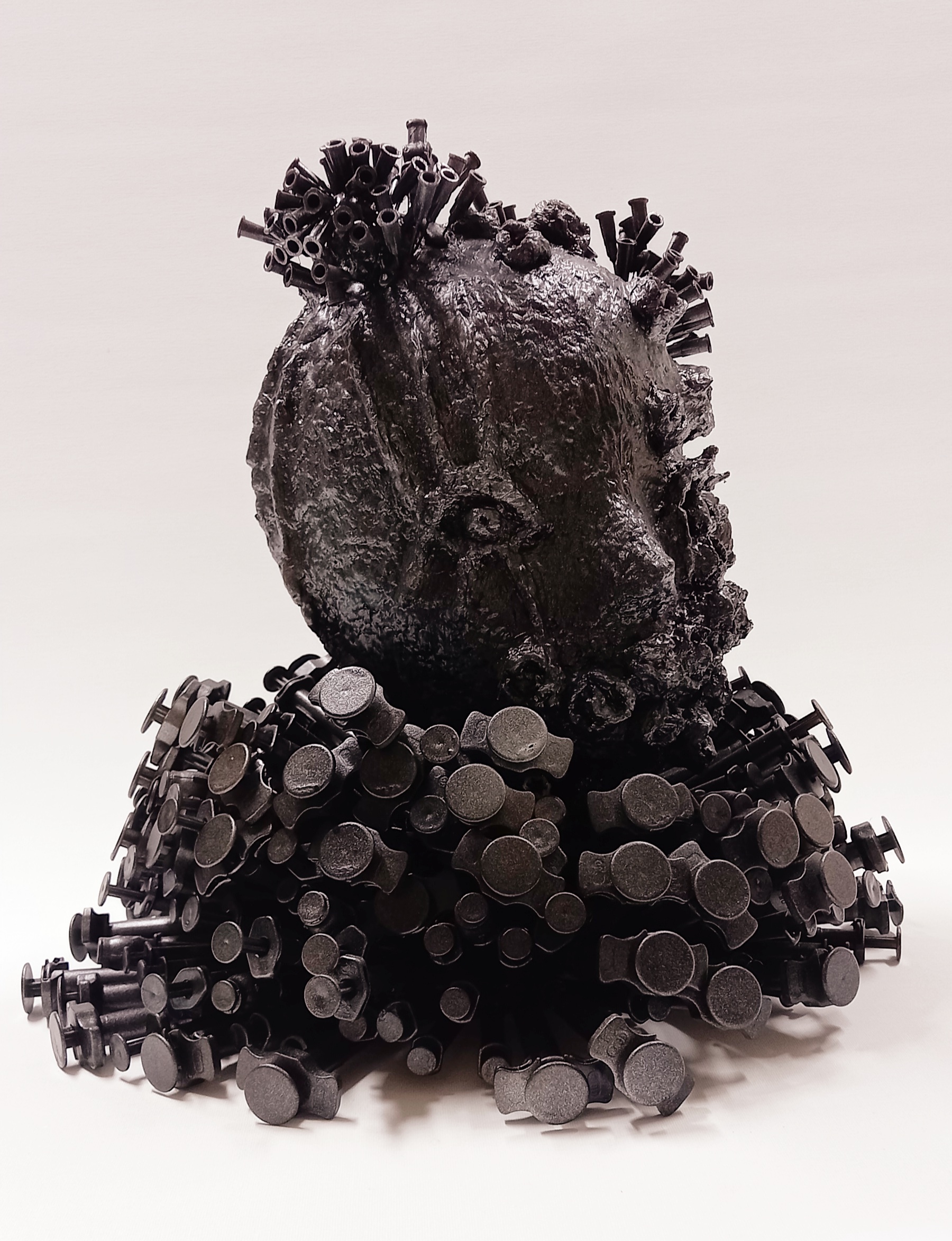
Shani Eldar too suffered trauma as a child; at 28, she was diagnosed with Multiple Sclerosis, an autoimmune disease in which the body attacks the protective sheath that covers the nerve fibers of the spinal cord, causing physical pain and communication issues with the brain. Shani did not speak of her trauma with anyone until much later in life, and now believes that her internalized pain may have caused her disease to manifest. In the painting, “I Said Nothing”, Shani uses Morse code over an abstract cacophony of color to communicate her call for help, both referring to her silence about her trauma and her later attempts to hide her disease from the world around her in order to avoid stigma. While going through her initial treatments in 2009, Shani fashioned “Injected” from a Styrofoam head and the syringes she used to administer her medications. The medications had side effects that were almost as bad as the disease, and at times, Shani felt like a guinea pig. Seven years ago, Shani went off all medications, and though her disease still influences her life, she feels stronger mentally and is able to navigate the world better and more openly.
Kefaia Aiaite’s trauma occurred when she was already an adult with children; her husband became addicted to drugs and became abusive. Her trauma is multifold, because as an Arab Muslim who lives in Israel, she also contends with the hardship of a family split up by borders and the difficulty of navigating her feelings about her nationality. Kefaia’s dancer is surrounded by a swirling colorful cloud of pills. During the period of her abuse and separation from her husband, Kefaia fell ill with multiple illnesses, as well as a deep depression. At one point she was taking 33 pills, three times a day. Some of them had terrible side effects. She says her art and her writing saved her and now she takes very little medication; her dancer is celebrating her freedom from the pills. In a close-up portrait of just one eye, with Kefaia’s real hair attached to it, she examines how sometimes, when we cover one eye, the picture is clearer. She used her real hair in the image because for her, hair is holy and also connected to health. In another work with an image of the map of Israel and Al-Aqsa mosque in the center, Kefaia explores her generational trauma. She created the work during a period when there were clashes between Israeli police and worshippers at Al-Aqsa Mosque. For Kefaia, conflict on this site, holy to her, crosses a line. In the upper right is a portrait of her grandfather, a man who lived 124 years and saw many transformations of the land. In the painting, people work the land as he did. In a tree which intertwines with the map is a girl on the swing, the carefree persona Kefaia wishes she could be, and a woman helping a boy in the branches, the woman she became. Kefaia has family on both sides of the green line, as well as family that fled to Jordan and Syria in 1948. Maintaining ties with them is difficult. The family in the Palestinian Authority must get permits to visit her and her other family members in Israel. Every life cycle event that both sides wish to attend becomes a bureaucratic nightmare.
I AM AN IMMIGRANT
Through their works, Polina Bar Cohen, Chana Spitzer and Avi Telala each explore immigration and the ethnic minorities that they are a part of in Israel.
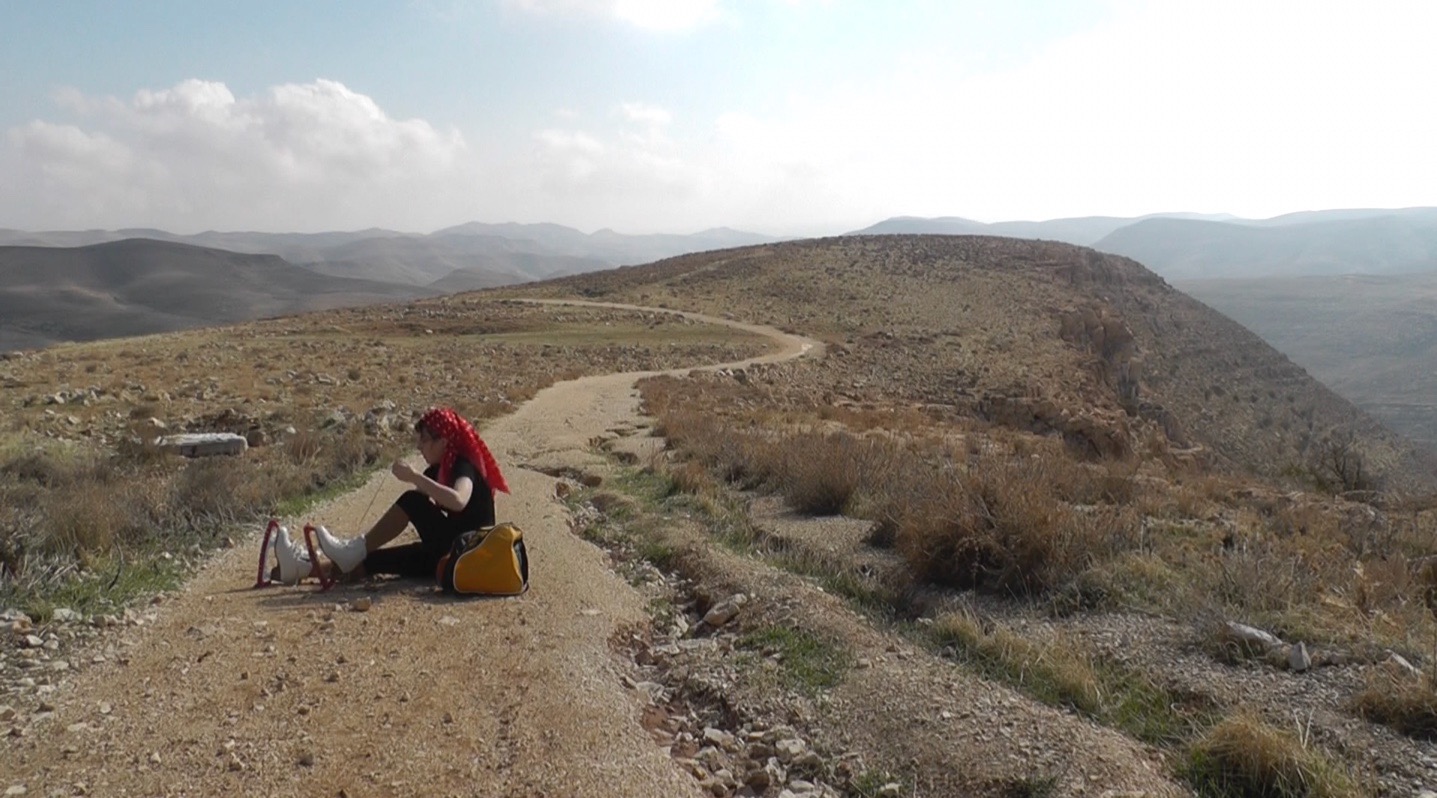
Although Polina Bar Cohen was born in Israel, her parents came from Russia and she feels deeply connected to her Russian roots. She married a Russian-speaking man and speaks Russian in her home. In her video artwork “A Walk in the Desert”, Polina sits on the ground, with the view of the Judean desert behind her. Wearing ice-skates, she traverses the rocky, dry path. In Russia, ice-skating is commonplace and a source of pride as a sport the country excels in. In Israel, it is not easy to find a rink and ice-skating is not part of the country’s culture. Polina’s difficult walk, in her inappropriate footwear, illustrates how awkward it can be for immigrant children to navigate their two cultural identities and walk their own paths through life.
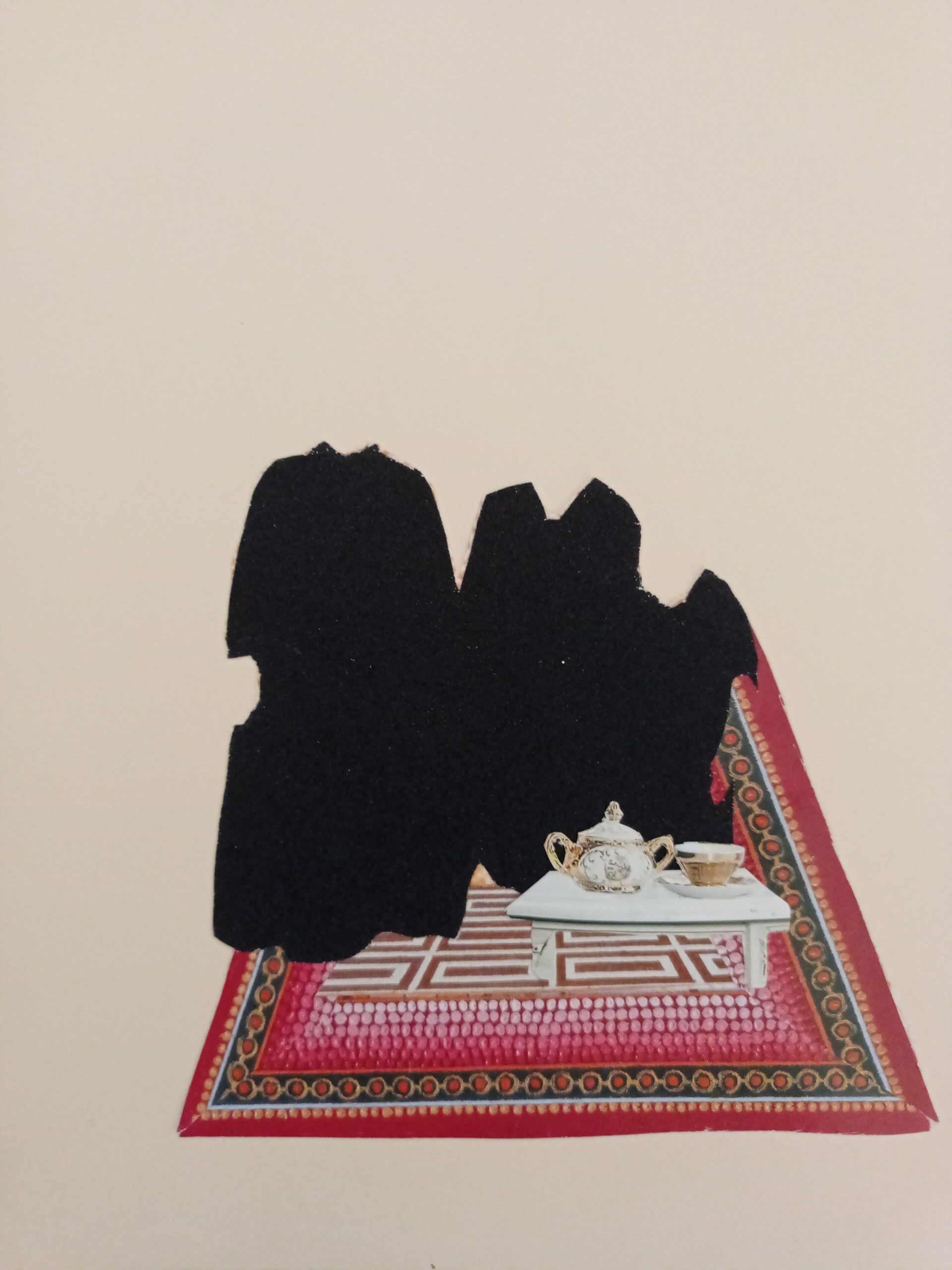
Chana Spitzer’s series of works explore her Bukharan roots. Her grandmother and great-grandmother came to Israel from Uzbekistan in the 1920s because of their Zionist fervor and to escape religious persecution. They came from a relatively comfortable lifestyle but, as refugees, they arrived in Israel with next to nothing. Because they were involved in fabric sales and seamstress work, Chana took a deep interest in the clothing they are wearing in a photograph taken shortly after their arrival in Israel. Israeli society encouraged Chana’s foremothers and their families to assimilate and little of their culture survives in Israel today. Chana created a series of works depicting just the clothing, without the people, animating them through collage, color and abstraction, each work examining a different aspect of what it meant to be an immigrant from Uzbekistan at the time. The absence of people hints at the damage the over-assimilation wreaked. Chana also created a collage of her grandmother in her wedding dress, celebrating the color and texture that were an integral part of her family’s culture. Chana’s works illustrate and preserve that lost culture.
Avi Telala came to Israel in 1984, at the tender age of four, during Operation Moses, the first wave of Ethiopian immigrants that came to Israel. This group of Ethiopian immigrants came through Sudan on foot before boarding planes to Israel. Avi’s family paid a huge price; his mother did not survive the harsh journey. From the moment they arrived in Israel, Avi did his best to integrate into the new society and bridge the cultural gaps. Like many of his peers, he heard the story of the Ethiopian Jews being rescued by the Israelis, while the true story was that the members of his community took their fate in their own hands and gave up their lifestyle and their homes and embarked on a perilous journey to reach Jerusalem, only to receive paltry recognition for their part in the narrative.
But with time, Avi began asking his elders questions and learned that the Ethiopian arrivals had much more agency than was attributed to them. After his military service, Avi took a month-long trip to Ethiopia to the regions from which his family came. Meeting people who knew his parents and other Jewish people who left, revealed to him his past and the Jewish history in Ethiopia. The people he met told him about the impact the Jewish people had on the history of Ethiopia as a state and a society for thousands of years.
When Avi returned to Israel, he worked with youth at risk and in his city, 70% of them were Ethiopian. Avi felt these youth had no pride in their roots, and many did not even know their parents’ names in Amharic, either out of embarrassment, lack of knowledge or a desire to break away from their past. As a result of this impression, Avi developed a unique program that is now used statewide, which teaches Ethiopian Jewish and Zionist values to Ethiopian Jews and in turn strengthens their sense of belonging to, and love for, the State of Israel. Two or three times a year, Avi brings groups of young people and ordinary citizens to Ethiopia on a meaningful and unique journey where the travelers go through internal growth, dealing with issues of personal responsibility while experiencing how their ancestors lived, meeting Jewish Ethiopians who still live there (the Falash Mura who, like the Conversos in Spain, had hidden their Judaism) and learning to appreciate the rich opportunities they have because of the sacrifices that their parents and grandparents made in order to come to Israel.
From an early age, photography has been Avi’s passion and he squirreled away his allowances to buy his first camera. When he takes photographs on his trips in Ethiopia, he imagines himself as the person on the other side of the lens; the girl with her mother, the tribal Ethiopian men sizing up the tourists, the Falash Mura children running by the sign of the Synagogue in the Gondar transit camp as they wait years for the State of Israel to welcome them home.
He challenges himself and the people he takes to Ethiopia to imagine themselves in the shoes of the locals and, in the process, he shapes young Israeli leaders who know where they are from and how high they can fly.
I BELONG... SORT OF
These nine artists, Nadav Teitelbaum, Svika Altman, Efrat Dorel, Hana Libi Yaar, Shani Eldar, Kefaia Aiaite, Polina Bar Cohen, Chana Spitzer and Avi Telala, express their identities in their artworks and analyze which groups they feel part of. Through their works, we can glimpse the great variety of types of people in the world, empathize with an individual’s struggles and thus better understand and humanize the groups they align with.
We use groups to describe our identity in order to help others understand us and get to know us as unique multifaceted individuals. Though the groups and communities that become integral parts of a person may conflict, it is precisely those conflicts within the individual that create a space for dialogue among the different groups. People balancing multiple identities are exactly the people who can create change and promote tolerance, within both themselves and their communities.
.JPG)
.JPG)
.JPG)
.jpg)