Spotlight from the Adama Exhibition: Aya Chaya Altman
Aya Chaya Altman is a multidisciplinary artist, photographer, and social activist whose work merges body, memory, and identity with the charged landscapes of the southern region where she lives. Beginning her academic studies at age 40, during recovery from advanced breast cancer, Aya describes that period as an awakening: a reclamation after years in which she had fallen silent. Her artistic practice is rooted in the exploration of bodily visibility, illness, female representation, genetic inheritance, and cultural history.
The daughter of a Polish Holocaust survivor and a mother born in Morocco who was uprooted from her home in the middle of the night and brought to Israel without her parents, Aya has built a powerful body of work around what she calls “cultural genetics”, the meeting point between ancestry, trauma, and the body as a remembering vessel.
In the Adama exhibition, Aya presents four large-format photographs printed on fine art paper. Together, they reflect a profound inquiry into protection, vulnerability, heritage, and the fragility of life in the liminal spaces of Israel’s southern borderlands.
“Protected Space” (2024) was taken inside a greenhouse covered in plastic sheeting. This lyrical photograph flattens the natural world into delicate silhouettes: weeds pressed like ink strokes against the translucent surface, illuminated by the sun. The result recalls a Japanese screen—minimal, meditative, and almost hand-drawn.
But the title, “Protected Space,” complicates the serenity. In Israel, a “protected space” refers to a safe room built to withstand rocket attacks. As a resident of the south, Aya knows these reinforced concrete spaces all too intimately. Her gentle image quietly questions what it means to seek safety in a region where the very idea of protection is perpetually in doubt.
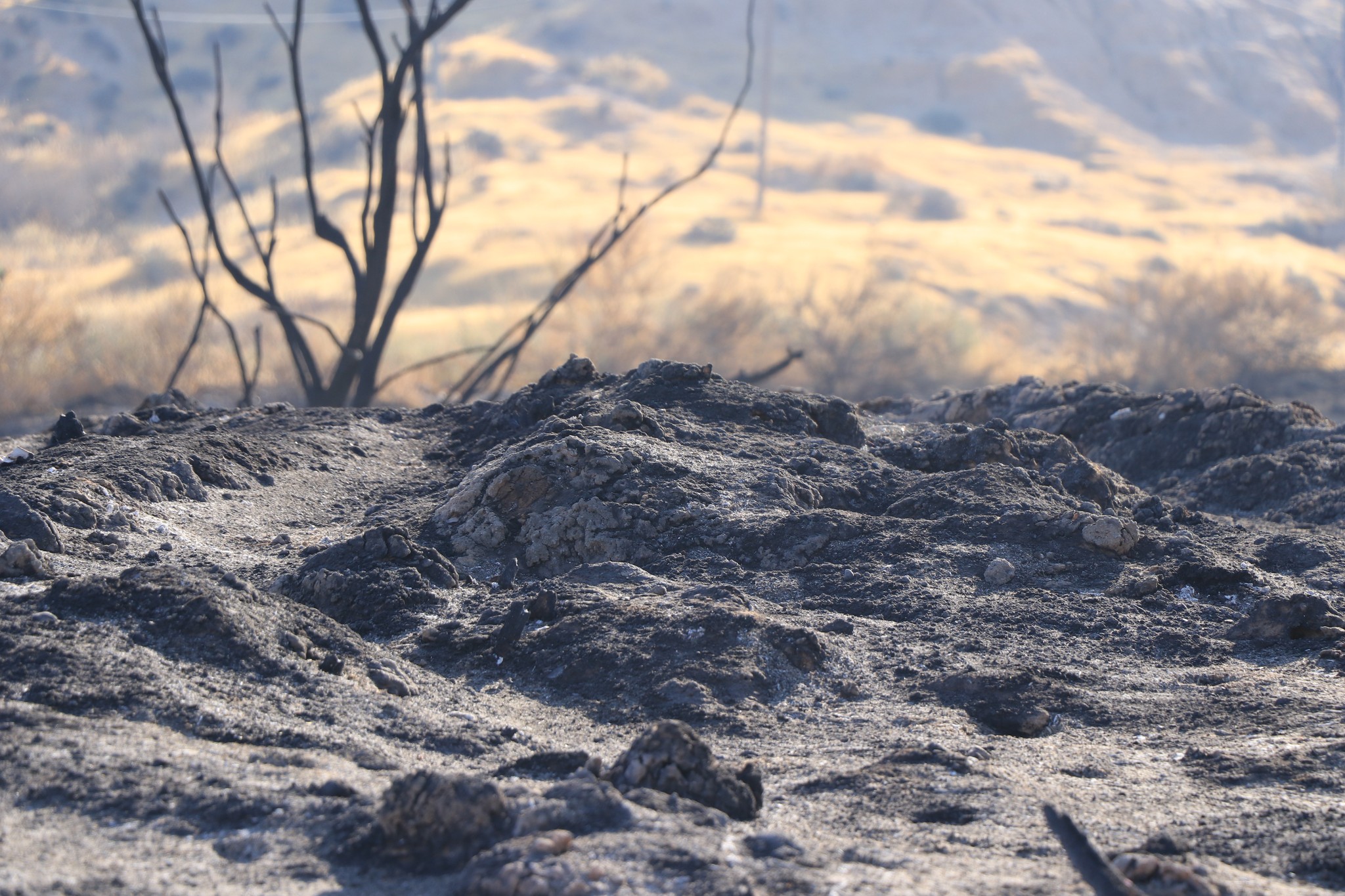
“Desert Winter” (2024), is a painful close-up of scorched earth, this photograph confronts the aftermath of an incendiary balloon attack; one of the recurring threats faced by communities near the Gaza border. The fire captured here occurred miles from the front, carried by winter winds that endangered an entire family before rescue forces arrived just in time.
Aya’s composition is both beautiful and devastating; the earth blackened to coal in the foreground and bare burnt bushes in the midground become the silent testimony of a landscape singed by violence. It is a stark reminder of the precariousness of life in rural border communities, whose hardships often remain unseen by much of the country.
“Zohara” (2024) and “Many Pictures in One – From the Film ‘The Four’” (2025) emerged from Aya’s project on “cultural genetics.” Zohara is a still photograph taken during the creation of the short film “Four (4 FOUR)”, while Many Pictures in One is a new composite constructed from multiple film stills.
In this project, Aya brings together four generations of women who shaped her identity: herself, her mother Hannah, her maternal grandmother Zohara, and her paternal grandmother Chaya. Though these women Aya stages a symbolic encounter; an act of remembrance that allows their stories, traumas, and legacies to converge.
The film was shot inside a greenhouse, a location Aya chose after wandering through the agricultural structures surrounding her home. She was struck by how the ordered rows, enclosed spaces, and taut wires resembled the crematoria imagery of Europe, particularly the “lower greenhouses,” where the earth is disinfected beneath thick plastic and strings dangle like suspended lines.
Altman’s practice exists at the intersection of personal history and collective narrative. Her photographs in the Adama exhibition reveal an artist who translates trauma, ancestry, illness, and the tension of borderland living into images of striking beauty and emotional depth. Whether confronting scorched earth, ancestral memory, or the illusion of safety, Aya’s work invites viewers to consider how the body carries history—genetic, cultural, and geographic—and how art can transform that burden into a space of visibility, connection, and resilience.
,_נפגשות_בתמונה_אחת_מתוך_וידאוארט_הארבעה_,_2024,_סטיל_מהסרט_מודפס_על_נייר_פיין_ארט,_30x60_סמ.jpg)
Aya Chaya Altman (Talmi Yosef), Many Pictures in One – From the Film “The Four”, 2024, still from the film printed on fine art paper, 30x60 cm
,_מתוך_סדרת_הצילומים_זהרה,_2024,_צילום_דיגיטלי_מודפס_על_נייר_פיין_ארט,_80x120_סמ.JPG)
Aya Chaya Altman (Talmi Yosef), From the series “Zohara”, 2024, digital photograph printed on fine art paper, 80x120 cm
,_מרחב_מוגן,_2024,_צילום_דיגיטלי_מודפס_על_נייר_פיין_ארט,_80x120_סמ.JPG)
Aya Chaya Altman (Talmi Yosef), Protected Space, 2024, digital photograph printed on fine art paper, 80x120 cm
,_חורף_מדברי,_2024,_צילום_דיגיטלי_מודפס_על_נייר_פיין_ארט,_80x120_סמ.JPG)
Aya Chaya Altman (Talmi Yosef), Desert Winter, 2024, digital photograph printed on fine art paper, 80x120 cm